Tuesday, January 8, 2008

Three Presidential Candidates Discuss Global Warming

Presidential Candidates' Forum on Global Warming and Energy Security

At the end of 2007 all the presidential candidates were invited to participate in a forum on Global Warming and Energy Security. Edwards, Clinton, and Kucinich gave speeches and answered questions (REAL questions about climate change and energy). To hear what they had to say, check out the audio from Living on Earth.

"The torch has been passed to a new generation. We are the generation that we've been waiting for and we just need to move forward, with courage and compassion and with vision, to create the world that we want." JFK

Wednesday, November 14, 2007

A Great Climate Resource

Interested in keeping up to date on climate issues? Frustrated by some well-known climate blogs that cage information in language you have to plough through to understand? Check out this great blog site by author Joseph Romm (Hell and Highwater). His site is authored by him, as well as a variety of professionals, and of course the requisite number of looney commentators. ClimateProgress

Friday, September 14, 2007

Kick the (Bad) Habit

Television is pretty ubiquitous these days. The average American spends more than 4 hours per day watching television (source), which adds up to about 9 years of watching TV in a 65-year life. Time is precious, and its easy to get sucked into watching more television than you meant to. Think about how much you could get done if you stopped watching television (hiking, reading, applying for the job you really want).

Additionally, TV has a very significant impact on the lives of children. According to one report, children see about 40,000 advertisements a year (source), and its been shown that because they are less able to understand that commercials are a biased attempt to sell a product, they often believe what commercials portray, sometimes leading to depression. One study says that on average parents have 3.5 minutes of meaningful conversation with their children per week, who in turn, spend 1,680 minutes per week watching TV (source). Who would you listen to? Finally, if your kids are watching hours of TV a day, that means they are inside, more or less stationary. Think about how beneficial to their health and imagination reading a book or playing outside could be!


So try and cut TV from your life. Instead, take a hike with your loved ones, read that book you've always wanted to, or find a project that gets you involved with your community (ex. stepitup2007.org).

For more information, check out newdream.org.

Wednesday, August 29, 2007

Tap vs. Bottled Water


The best way to save resources is to not use them in the first place. One easy way to shrink your global footprint is to not drink bottled water.

Reasons to drink from the faucet:
1. It's free! It costs about $0.49/year to drink the prescribed 8 glasses/day tap water, and about $1,400.00/year to drink bottled. 40% of bottled water is just filtered municipal water. What a scam!
2. 9 out of 10 bottles are NOT recycled. There are 30 million discarded bottles per day in the U.S.
3. It takes 1.5 million barrels of oil to make one year's worth of plastic bottles.
4. It takes fuel and releases emissions to transport bottled water.
5. Disposable plastic bottles can contain toxic substances.

So, instead of spending money for water you could get for free (in addition to utilizing resources unnecessarily), carry a reusable drinking container and fill up at any faucet!

Want to learn more? Check out these news items from NPR.

Black Screens Save Energy

Check out Blackle.com. It's a search engine, powered by Google, but with one small, but possibly important difference: a black background. Black computer screens take less energy than white screens, and so having blackle.com as your homepage or standard search engine could eventually mean energy savings, especially if everyone who uses google switches over. They also have some tips for easy ways to save energy in your home and car, so check out their tips page.

You can't help but wonder... if the site is powered by Google, why doesn't Google.com just switch to a black background?

Saturday, August 11, 2007

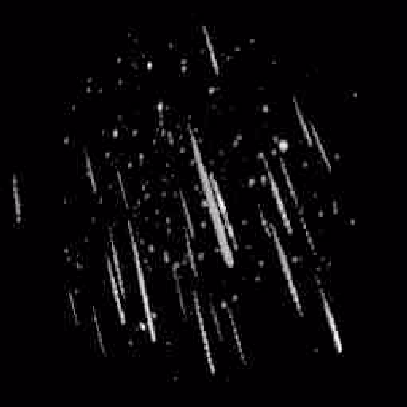
It's a bird, it's a plane, it's... meteors!


The peak of the Perseids, an annual meteor shower, happens from dawn to dusk on the August 12th-13th. This year the moon is positioned in such a way as to allow the best viewing during the peak of this years shower. In really dark skies you may see as many as 80 meteors per hour!

Meteors are comet dust that burns up as they graze the earth's atmosphere. This particular annual shower has been observed by the people of the earth for more than 2000 years. Get outside on the night of the 12th for an amazing show!

Saturday, July 21, 2007

What a Hoot

"The value we place on any given plant or animal is really a reflection of what we know about it and its place in our surroundings." Janis Higgins, author of Wild at Heart

I recently did some research for an educational program on owls. I learned a lot of really neat facts about these amazing raptors, and here are some of my favorites:

* Raptor come from the Latin word "rapere" meaning to grasp and carry away. Raptors (including owls, hawks, eagles, and other birds of prey) use their taloned feet to capture and kill animals. Owls eat frogs, lizards, snakes, fish, mice, rabbits, birds, squirrels, and insects, among other things.
* Many owls fly almost silently. This is thanks to the stiff fringe on the outer edges of their forward wing feathers that look like a comb. The rear wing feathers have a soft, hair-like fringe. These fringed edges soften the flow of air as it moves over the wings. The soft surface of the flight feathers absorbs the noise the feathers make as they slide over one another.
* Owls can’t move their eyeballs, so they must turn their heads to change the direction they are looking. They have 14 neck bones (twice as many as we have) which allow them to turn their heads 270 degrees in both directions.
* Many owls have asymmetrical ear placement, this gives them "3-d" hearing. Since their ears are not evenly placed, sounds may reach one ear before the other. They then tilt their heads until the sound reaches both ears at the same time. This tells them exactly where the sound is coming from, even without seeing the source.
* Some owl species have eyes larger than humans. Owl eyes may account for 15% the weight of their heads. Also, they have more rods (responsible for seeing in low light) and fewer cones (responsible for seeing color). This means they can see really well in the dark, but don’t see much color. They have visual sensitivity between 35 and 100 times better than out own.

Owls and other birds of prey are a vital part of the ecosystem. They keep rodent populations in check, and can be used as an indicator species for the health of their habitat. To protect these birds, it is crucial that they have ample habitat, and are not exposed to dangerous pesticides and pollutants. To protect land, donate or volunteer with your local land trust. If you see an injured raptor, contact a wildlife rehabilitation center.


Great horned owl (Bubo virginianus)